PROJECT LEADS
James Leverton, AECOM | Maria Cardenal, Bluefield Research | Emma Grace, Anglian Water | Robbert Lodewijks, HULO | Idel Montalvo Arango, Ingeniousware | Peter van Thienen, KWR Water Research Institute | Tom Swain, Samotics
CONTRIBUTORS
GianLuca Rolandelli, ABB | Joana Teixeira, Joana Araujo, Moisés Neves & Filipe Costa, Águas e Energia do Porto | Andy Smith, Anglian Water | Alexander Ncube, City of Cape Town | Markus Sunela, Fluidit | Gitte Rosenkrans, HOFOR | Frank van der Hulst, HULO | Adam Wood & Marco Westergren, InfoTiles | Athanasios Serafeim, Innsyst Consulting | Fionn Boyle, Jacobs | Dragan Savic, KWR Water Research Institute | Martin Shaw, MGISS | Harald Rishovd, Oslo Kommune | Kristina Bognar & Matt Theakstone, Schneider Electric | Jeremy Heath, SES Water | Titti Wästlund, Smartvatten | Tom Woolley, SUEZ Digital Solutions | Kevin Shipp, Transcend | Agnethe Nedergaard Pedersen, VCS Denmark | Joukje Keuning, Vitens


– F. Javier Fernández Delgado, Subdirector de Telecontrol, Canal de Isbael IISWAN’s Adaptive Data Management Guide presents a clear, expert-driven roadmap for advancing water utility operations, offering practical solutions in data integration, cybersecurity, and system interoperability that are both timely and impactful.
Overview
Drawing upon insights from diverse water utilities and industry experts, the new SWAN European Alliance collaborative research report provides a foundational guide for water utilities. Divided into two papers with first-hand utility case studies, the first report outlines common data challenges and practical implementation advice. The second paper highlights strategies for climate resilience planning from scenario development and infrastructure design to the use of digital tools.
1. Data Stewardship and Strategy
This section paper defines the core elements of data stewardship and how a comprehensive data strategy can drive operational efficiency, innovation, and compliance. It delivers actionable tactics to overcome organisational resistance to change, including a detailed case study about the City of Cape Town’s successful data stewardship approach across technology, people, and process dimensions.
2. Cybersecurity and Business Continuity
This section paper explores the evolving cyber threats within the water industry, identifying key terms to know like “smishing” or “quishing” and ways to develop a people-first cybersecurity culture. It also provides cyber resilience and gamification techniques (including SWAN superheroes and a cyber villain you can repurpose), concluding with lessons gained from Águas e Energia do Porto’s cyberattack experience.

3. Data Interoperability and Integration
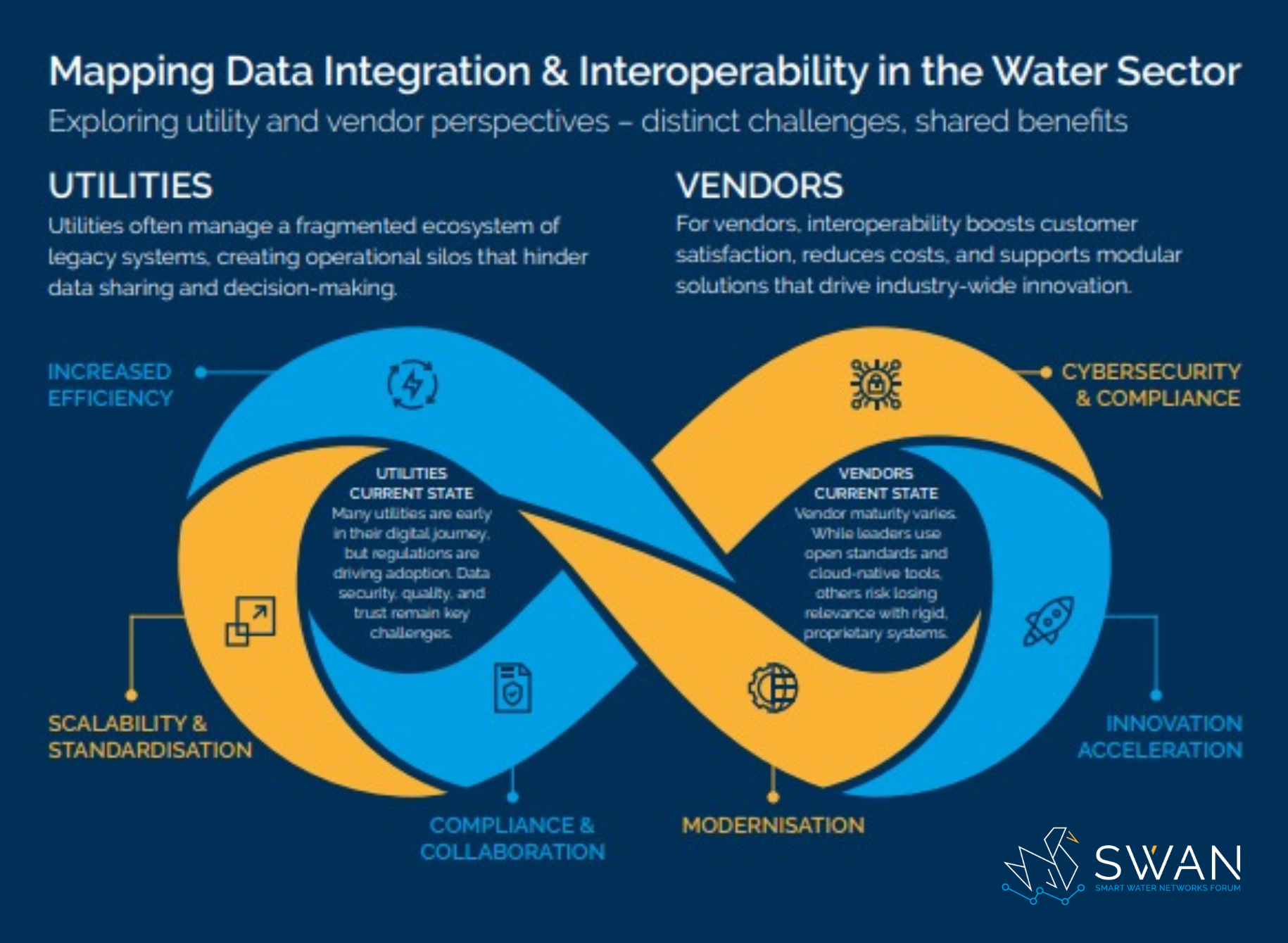
This section paper highlights how data interoperability and integration are critical for modernising water utilities, improving operational efficiency, and supporting innovation. It explores both utility and vendor perspectives, outlining shared challenges and opportunities for collaboration with a summary infographic. It further showcases six innovative utility case studies from Denmark, the UK, Brazil, and Puerto Rico.
4. Climate Resilience
This second paper explores the impact of climate change on water utility systems and presents practical strategies for incorporating climate considerations into resilience planning through scenario development, infrastructure design, and digital tools. It introduces a new, interactive “SWAN Climate Resilience Framework” for benchmarking and QGIS plugin for resilience analysis. It also features four utility case studies – covering topics from preventing seawater infiltration in Norway to mitigating climate-related pipe bursts in the UK with digital solutions.

Membership required to view full reports
SWAN membership grants access to a community of thought leaders, cutting-edge reports and resources, participation in global Alliances and Communities of Practices, networking opportunities, promotions, events and much more.